
Bursa Malaysia Slides 22 Points at Midday as Global Tech Sell-Off Weighs on Local Stocks
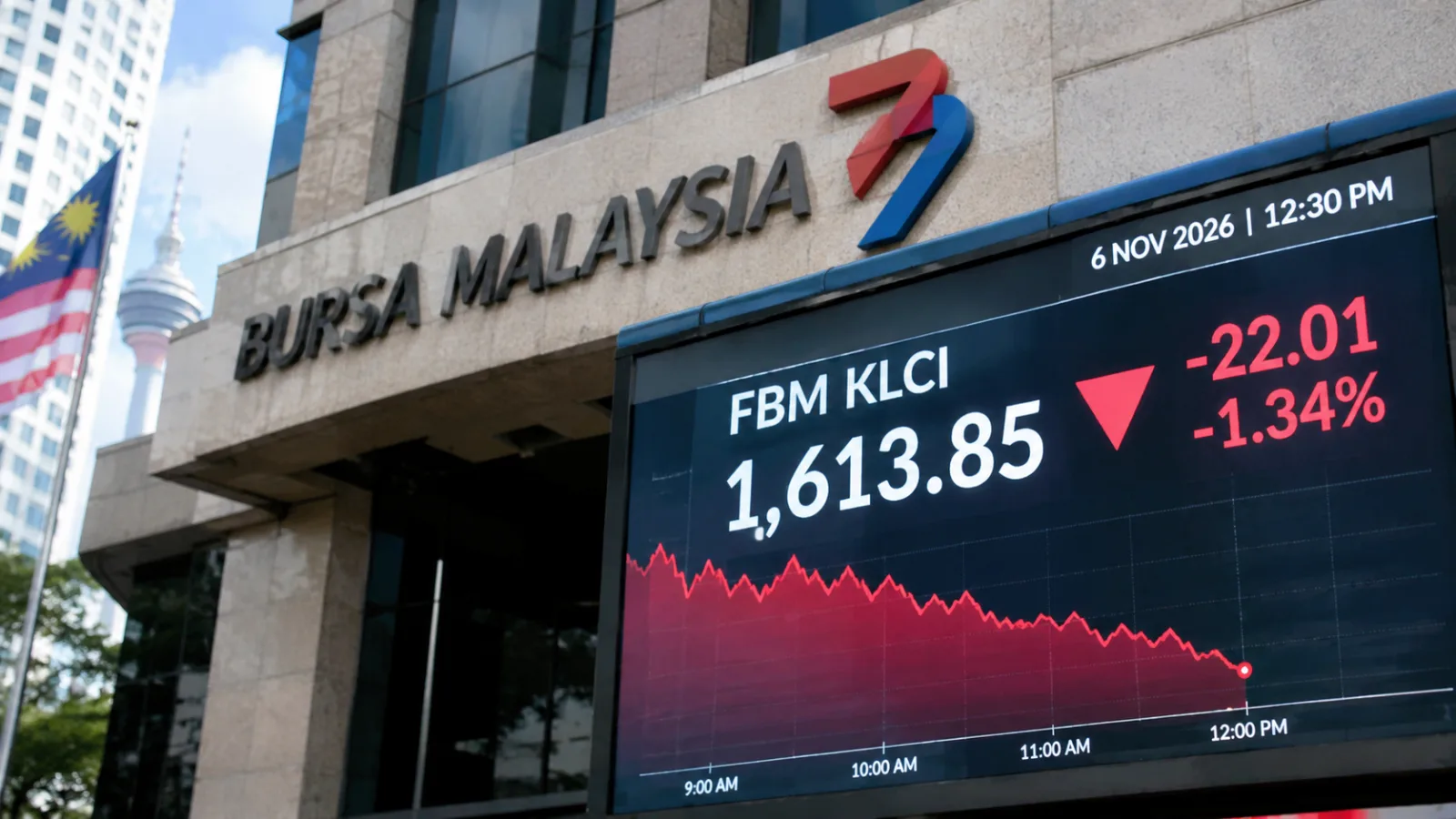

KUALA LUMPUR, Nov 6 — Malaysian equities fell sharply during Friday's morning trading session as weakness in global technology stocks spread across regional markets, placing pressure on major banking, utility and semiconductor counters.
At 12.30pm, the FTSE Bursa Malaysia KLCI (FBM KLCI) stood at 1,613.85 points, down 22.01 points or 1.34 per cent from Thursday's close of 1,635.86.
The decline followed an overnight sell-off on Wall Street, where renewed concerns about artificial intelligence valuations and regulatory developments affected investor confidence.
Most listed stocks traded lower
The weakness was evident across the broader Malaysian market.
By midday, 963 counters had declined, compared with 210 gainers, while another 308 remained unchanged.
Total trading volume reached approximately 2.34 billion shares, valued at RM1.73 billion.
Within the FBM KLCI, 27 of the 30 constituent stocks were trading lower, with only one advancing and two unchanged.
The figures indicated that selling pressure extended beyond a small number of technology companies.
Global technology concerns affect Malaysia
Technology stocks came under renewed scrutiny following sharp losses in US markets.
Investors were reassessing whether valuations for some artificial intelligence and semiconductor companies remained justified by their future earnings and spending prospects.
Potential changes in US regulation also contributed to uncertainty surrounding the sector.
Because Malaysia participates in international semiconductor manufacturing and technology supply chains, local technology-related stocks were affected by the shift in market sentiment.
The Bursa Malaysia Technology Index fell more than 6 per cent shortly after the opening bell, according to market reports.
However, fluctuations in share prices do not necessarily indicate an immediate deterioration in the underlying businesses.
Semiconductor counters face selling pressure
Malaysian Pacific Industries (MPI) was among the stocks affected, declining RM2.68 to RM36.20 by midday.
Inari Amertron fell 14 sen to RM2.14, while UWC dropped 28 sen to RM6.31.
These companies operate in industries connected to semiconductor manufacturing, testing and precision engineering.
Their share prices can be sensitive to changes in global technology investment expectations, manufacturing demand and broader investor sentiment.
Market participants will therefore be watching future corporate earnings and industry developments to distinguish short-term volatility from more lasting business changes.
Banking heavyweights also decline
Financial and utility stocks added to the downward pressure on the benchmark index.
Maybank lost 10 sen to RM10.06, while Public Bank declined seven sen to RM4.89.
CIMB slipped eight sen to RM7.07, and Tenaga Nasional fell 18 sen to RM12.92.
The performance of these large-cap companies has a substantial influence on the FBM KLCI because of their index weightings.
As a result, weakness among major banking stocks can cause the benchmark to decline even when some smaller companies are performing more strongly.
Analysts highlight several market risks
Hong Leong Investment Bank identified the overnight decline in US equities as one factor affecting local sentiment.
The investment bank also highlighted the possibility of profit-taking following the recent recovery in Malaysian shares.
Other considerations included uncertainty surrounding November corporate earnings, investor portfolio adjustments and caution ahead of the Deepavali holiday.
It also noted that Malaysia's growing exposure to AI and data-centre investments could make the market sensitive to changes in global spending expectations.
These factors represent market analysis rather than proof that any single development caused the entire decline.
Investors urged to monitor developments
The latest movement demonstrates how global financial developments can influence Malaysian equities, particularly in sectors linked to international technology supply chains.
Investors may wish to consider corporate fundamentals, earnings expectations, valuations and their individual risk exposure instead of relying solely on one day's price movements.
A sharp decline does not automatically indicate a prolonged market downturn, just as a rebound is not guaranteed.
The figures in this report reflect trading conditions at 12.30pm on November 6, 2026, and should not be treated as the final market close.
#ASIA899News #MalaysiaNews #BursaMalaysia #KLCI #StockMarket #TechnologyStocks #MalaysiaEconomy #FinanceNews